
 FR
FR  NL
NL  DE
DE 
Esther Olsen-Velde and Michael Olsen
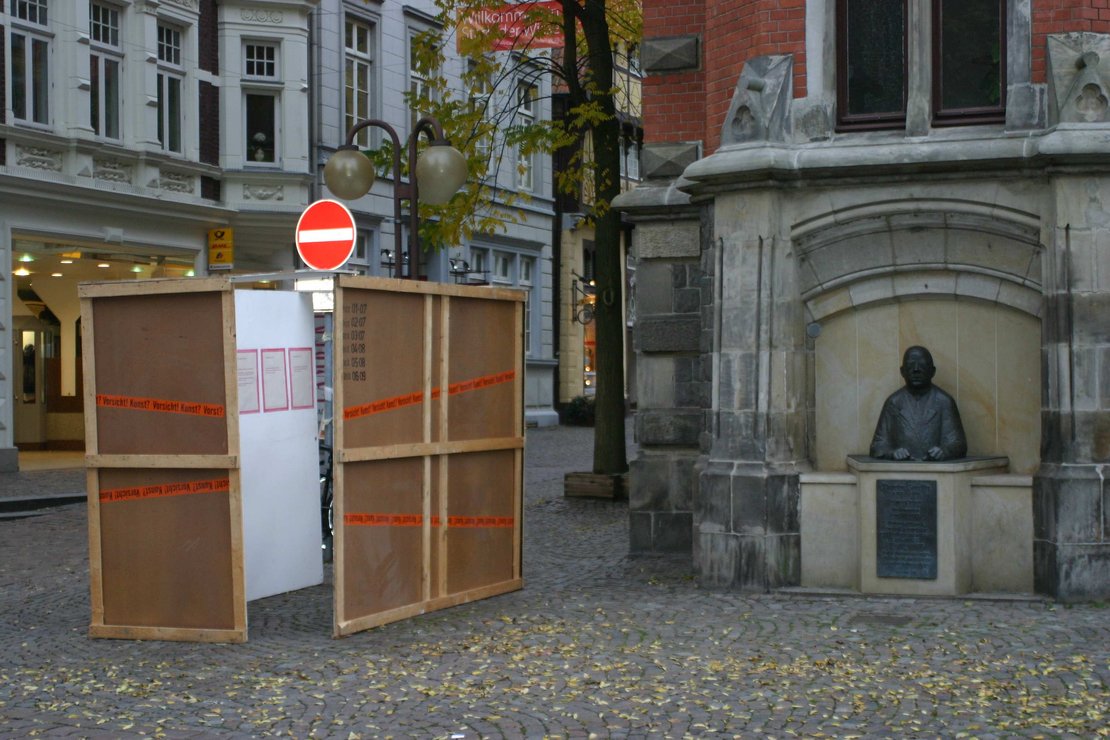
Be careful! Art?
Installation on the anniversary of the Reich Pogrom Night on 9 November and the date of 9 November in the history of Germany
HDF, Shawl, Text boards
320 x 220 x 110 cm, 9 November 2008
Texts on the boards
9 November 1848
Suppression of the democratic-bourgeois revolution by the execution of the Republican MP Robert Blum
9 November 1911
August Bebel, leader of the Social Democratic Party, gives a prophetic speech in the German Reichstag and sees the danger of war (the 1. World War I): ‘Then comes the catastrophe. Then the great general march is defeated in Europe, on which 16 to 18 million men, the men's flower of the various nations, equipped with the best murder tools against each other, come into the field as enemies. But I am convinced that behind the great general march is the great Kladderadatsch. Behind this war stands the mass bankruptcy, the mass misery, the mass unemployment, the great famine. (...). You have been warned.”
9 November 1913
The one-day general meeting of the Association of German Jews in Hamburg, attended by 2000 participants, points to the disregard for constitutional principles in the treatment of Jews in the German Reich and calls for equal rights for all citizens in view of the growing racism.
9 November 1913
On Fort Spitsberg (fortress Silberberg) near Wroclaw (today Wroclaw) a recreation home for the paramilitary, semi-state youth organization Jungdeutschlandbund, donated by the German Emperor Wilhelm II, is inaugurated.
9 November 1918
In Berlin, from the Reichstag, the German Republic is proclaimed by the Social Democrat Philipp Scheidemann.
9 November 1918
Karl Liebknecht proclaims the soviet republic in Berlin in front of the royal palace.
9 November 1918
William II declared his abdication as German Emperor, but not as King of Prussia.
9 November 1923
‘March to the Feldherrnhalle’ (Hitler putsch)
9 November 1923
In response to the Hitler coup (8./9. 11.) the Bavarian Commissioner General Gustav Ritter von Kahr orders the immediate dissolution and prohibition of the NSDAP and the right-wing radical associations Oberland and Reichsflagge. On the 11th On 9 November, this measure will be extended to the KPD of Bavaria. All social democratic and communist newspapers and magazines are also banned.
9 November 1923
The French ambassador François Marie Pierre de Margerie will present himself to Chancellor Gustav Stresemann to address the concerns of his government about the Hitler coup (8th/9th century). 11.) and the danger of a legal dictatorship in the German Reich.
9 November 1925
Establishment of the terrorist organisation "SS" (Schutzstaffel), elite organisation of the NSDAP. It was established as a party police force. In 1929 Heinrich Himmler took over the leadership of the 280-strong troupe and created from it a men's order with black uniforms, skull symbolism and strict selection criteria. The SS became the most important state protection force of the Nazis, its name is inextricably linked to the worst crimes of the fascists. H. Himmler’s motto ‘I do not have to practice justice, but to destroy and exterminate’ (March 4, 33) was ruthlessly implemented by the SS during the twelve years of terror rule.
9 November 1930
In the municipal elections in Oldenburg, the NSDAP became the strongest party. It can increase the number of its seats in the city parliament from one to 18 seats.
9 November 1938
The ‘Reich Crystal Night’ organised by SA men killed over a thousand Jews.
November 8 to November 9, 1939
A bomb attack on Adolf Hitler by Georg Elser in Munich's Bürgerbräukeller fails. Georg Elser: “I wanted to prevent the war.”
9 November 1939
In the Buchenwald concentration camp near Weimar, 21 Austrian and German Jews are shot after the news of the attack on Führer and Reich Chancellor Adolf Hitler arrives.
9 November 1949
In the GDR, former members of the NSDAP, provided they were not classified as activists or convicted of war crimes, as well as former officers of the German Reichswehr, receive all civil rights again.
9 November 1967
Shielded by a huge contingent of police, the first hearing on the questions of emergency legislation begins in Bonn. A banner reads: ‘Unter den Talaren Muff von 1000 Jahre’ (Under the Talaren Muff of 1000 Years). The students protested against what they saw as a lack of reappraisal of the crimes of the so-called ‘Third Reich’ in post-war West German society, as well as against elitist structures and obsolete traditional lines of university politics. They demanded their democratization and the co-determination of the student body.
9 November 1974
In the Wittlich prison, the alleged ‘RAF’ member Holger Meins dies as a result of a hunger strike.
9 November 1974
In Mülheim an der Ruhr, the ‘Deutsche Soziale Union’ (German Social Union) is founded as a federal party. Vice-Chair Helmut Kasper stated that the party "wanted to stand unbreakably behind the admired ... and recognized Dr. Franz Josef Strauss for a new national reliability".
9 November 1983
The Catholic Bishops of France at their Plenary Assembly in Lourdes approved nuclear deterrence as a means of preventing war.
9 November 1989
The GDR opens the borders to the Federal Republic of Germany and West Berlin.
9 November 1990
Chancellor Helmut Kohl and Soviet President Mikhail Gorbachev sign the ‘Treaty on Good Neighbourhood, Partnership and Cooperation’ in Bonn. They agree on close political and economic cooperation between the two countries.
9 November 1998
Berlin: At the central event for the 60th anniversary of the pogroms against the Jews in Germany on 9 November 1938, Federal President Roman Herzog described the pogroms as one of the worst and most shameful moments in German history.
9 November 1999
In the presence of George Bush and Mikhail Gorbachev, the German Bundestag is celebrating the tenth anniversary of the fall of the Berlin Wall.
9 November 2001
Dresden: 63 years after the destruction of the old Jewish church, a new synagogue is consecrated.
9 November 2003
In the presence of Federal President Johannes Rau, the foundation stone is laid for the new Munich Synagogue and the Jewish Center.
9 November 2004
Across Germany, the opening of the Berlin Wall in 1989 is commemorated, which initiated the rapid end of the GDR on 9 November 1989.
9 November 2006
68 years after its destruction, the new main synagogue is ceremoniously opened in Munich.
9 November 2008
Commemoration of the Reich Pogrom Night: On the 70th anniversary of the pogrom night of 9 November 1938, German Chancellor Angela Merkel (CDU) warns against indifference to racism and anti-Semitism at the central commemorative event in Berlin's Rykestraße synagogue. Germany needs a climate that promotes civil courage.
9 November
A holiday or a day of remembrance?