
 FR
FR  NL
NL  DE
DE 
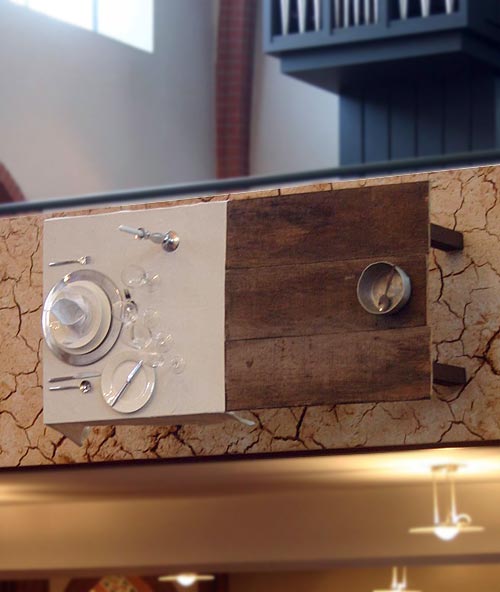
Installation for the German Evangelical Church Congress 2009 in the St. Ansagri-Kirchengemeinde Oldenburg
Esther Olsen-Velde and Michael Olsen
Material: Table, 150 cm x 75 cm x 70 cm (LxWxH), white/raw wood, tablecloth, crockery, cutlery, 1 x banner 600 cm x 95 cm
Topics: Food, food distribution, poverty versus wealth, abundance and hunger, "Where do I live?"
Description of installation:
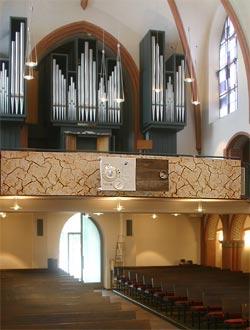
The parapet of the choir pore, in the back of the church visitors, is placed by means of a printed banner.
These banners are designed with the view of a dried riverbed - dried, cracked, loamy soil (see photo).
A table is hung on = in front of the banner of the choir pore, so that the legs "stand" on the vertically hanging banner. This also makes the table top of the table transversely perpendicular. Visitors to the church can thus see the table top in its top view.
This table is designed in such a way that its left half is richly decorated with white tableware, silver cutlery, wine glasses and white tablecloth, the other half -raw, rough wood, brown, poor - without any table covering, on the other hand, with a slightly dented tin bowl as dinnerware and a slightly bent tin spoon stuck in this dining bowl. It is consciously just a table to represent that all people are sitting "at one table", living in a common world. The table is set without perishable food, it is set only for a meal.
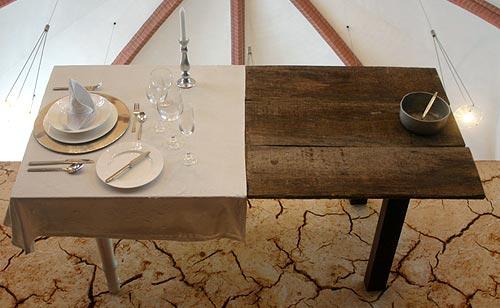 The tablecloth is plastinated by means of a special process. It is hard and stiff and falls from the tabletop to the legs, so whether the table is standing on the floor as usual. Dishes and cutlery are securely and invisibly attached.
The installation is mounted without any influence on the wooden panelled parapet. The installation is suspended from above over the edge of the parapet by means of specially made, invisible retaining clips. Any damage and danger is excluded.
 In the artistic language form of a spatial installation, this work refers to the distribution of food on the globe. Excess is juxtaposed with hunger.
The title of the work "Man, where are you?" addresses the visitor of the church with a question addressed directly to him and thus leads him to a self-given answer to this question: "Where am I?"
Conception: The installation "Man, where are you?" is a contribution to the topic of the different distribution of food in the world: Hunger versus abundance, luxury versus poverty.
This circumstance is to be visualized by the visitors of the church in an inviting and provocative way. The chairs next to the table should entice visitors to ask the question "Man, where are you?" to the autosuggestive answer "Where am I?", "Where am I sitting?".
However, the banner hung behind the table and chairs will give visitors a clear impression that all people live on the same livelihood and that it must be distributed fairly and for the good of all people.
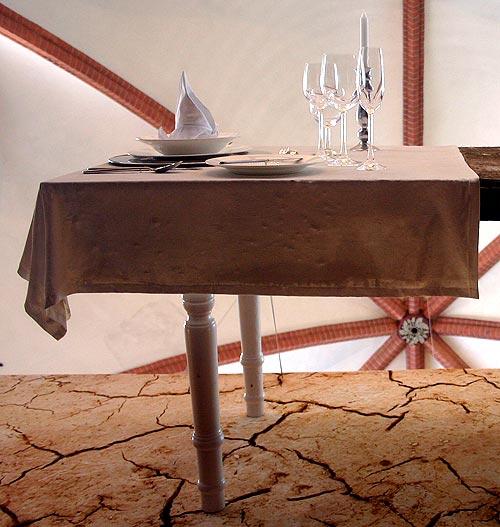 The depiction of the dried-up soil - the sign of lack of water and drought, drought, poverty - on the banners in front of the parapets conveys the danger to humanity: Lack of water affects all of us. Preserving creation means overcoming the current and spreading situation in the world with hunger and abundance, as well as poverty and wealth, in which the people of the rich nations and the people living in them must participate.
We would like to address the visitors with the title of the Kirchentag 2009 directly, let them decide for themselves where they stand, where they sit, whether the current state of the world is ethically justifiable.
It is part of the concept that the table and chairs are attached to the gallery armor of the choir gallery, i.e. in the back of the sitting worshippers.
The central part of the installation, the table and the two chairs, are only visible when going out of the church. The view of the installation is given to the visitors when they leave the church on the way "out", into everyday life.
And during the service, the mentioned problem lies in the back, it pushes us, it persecutes us, it lurks in the back, behind us all people.
Oldenburg, January 2009